Guidelines in situ

Fiona Moffatt, Thinking about guidelines:

My research interest lies predominantly in the notion of knowledge translation, exploring the complex, non-linear relationship between what is ‘known’ and what is subsequently ‘done’. I understand evidence based guidelines and evidence based policy as key rhetorical devices (or technologies) bridging the liminal space between empirical knowledge and clinical practice. My methodological perspective is however, strongly influenced by the sociological discipline of STS, whereby all technologies are contingent, i.e. rejecting technological determinism. Continue reading “Guidelines in situ”

Challenges to come

Roger Kerry, Thinking about guidelines:

My take home thoughts:

What is the real world, clinical role of guidelines? (provoked by Jeremy Howick’s suggestion that guidelines shouldn’t make recommendations, Sarah Weiten’s talk on values and mechanisms, and Sieste Wieringa’s talk on induction and reasoning)

Can a more holistic conceptualisation of causation really be integrated into guidelines which take population data as central to their development? (provoked by Stephen Mumford and Rani Anjum’s comments of the background philosophy of causation, as well as Karin Engebretsen and Elena Rocca’s talks on diagnosis and bench study data)

Can a guideline and evidence-based system truly move beyond hierarchies? (provoked by NICE’s Beth Shaw review of multiple evidence sources and their integration into guideline development. A beautiful talk, but I still think there is hierarchy at the core when push comes to shove. Show me I’m wrong!)

What is the future of implementation, governance, abuse-control strategies for guidelines? (provoked by Fiona Moffatt’s, Mary Chambers’, and Samantha Copeland’s highly informed musings on things from deep sociological concerns to PPI and the reality of the clinical shop-floor, and analogical thinking)

The planned conference for next year should turn out to be a hot-bed of challenge, controversy, and progress for all.

The Notion of Guideline

Stephen Mumford, Thinking about guidelines:

I was particularly interested in different models of decision making and the implicit assumptions we make about how this should work. In particular, the notion of a guideline seems up for grabs and I think it important that we do not inadvertently slip into one way of operating guidelines without philosophically scrutinising the idea. It would be easy, for instance, to interpret a guideline as a general rule, along the lines of ‘thou shalt not kill’. This sort of rule is interpreted as strict and exceptionless. The workshop confirmed that, irrespective of any intentions of those who write guidelines, there are pressures to follow them exactly. Failure to do so is often taken as a failure that leaves a clinician liable for any subsequent unfavourable outcome. Continue reading “The Notion of Guideline”

Ethics of Reduction

Karin Engebretsen, Thinking about guidelines:

The question that is still with me after the workshop is how the naturalist paradigm might affect the “political correct” attitude towards patients suffering from medically unexplained syndromes.

If the political decision makers within the medical field believe in the biomedical model as the provider of the best medical practice, their “worldview” will automatically influence the complete medical system.

The biomedical model excludes psychological and social factors and includes only biological factors in an attempt to understand a person’s medical illness or disorder. Thus, the biomedical model has a limited, reductionist attitude that divides the human body into separate elements, focusing on biological factors. Patients often seem to have a unique expression of their symptoms and a unique combination of biological, social and psychological overlapping symptoms. So how do reductionism and dualism affect clinical guidelines and diagnosing related to medically unexplained syndromes?

I see this question as related to ethical issues in medical practice and I hope there will be more focus on this fact as a critical mechanism.

How Decisions are Made

Elena Rocca, Thinking about guidelines:

I was interested in a question that Sietse threw at us many times: what should be the purpose of a guideline? What does “helping to make a good decision” mean?

We got some inputs about it throughout the whole day: it might mean including the patient view, or reporting only the evidence with no recommendation, or giving recommendation but being transparent about which evidence was considered and how it was judged, or again, as Sietse suggested, it might mean to explain what is “to make an inference”, what happens when a clinical decision is made. I was particularly interested in this last suggestion, and I felt it remained a bit “in the air”. Does it mean that we would need a guideline about the decision process? About the implicit and sometimes unaware stand that the clinician takes by valuing one or the other evidence, following the guideline versus personal judgement?

Real v Ideal Guidelines

Rani Lill Anjum, Thinking about guidelines:

I was really interested in the questions of how guidelines could include more leeway for the health professional. Rigid guidelines offering cost efficient solutions (e.g. 15 minutes per patient, or 30) emphasises the rule utilitarian approach and makes it difficult to use judgement and experience to give the best health service for the individual patient. If the patient represents at least as much of the causally relevant evidence (medical history, genetics, life situation, etc.) as population data, then how come the latter is given epistemic priority?

I thought that there were many good intentions behind the guidelines, but also a wide range of interests depending on who commissioned the guideline and what they want to use it for. This is why I thought the tension between real and ideal is important. New public management emphasises top down management, controlling, reporting, standardisation and efficiency. In the clinical setting, this approach might create chronic illness, if we simply treat or test the symptoms that the patient reports. Those who work on the importance of patient context and stories (Trish, Matt, Brian, Anna-Luise) have important knowledge to share, and show also that the most efficient treatment of such illness is to take more time with the patient to figure out what is actually wrong before offering an intervention or a test. Why could this not be in guidelines about chronic illness, MUS and comorbidity? Then we would also avoid reductionism and dualism of treatment.

Thinking about guidelines

clock-lion
National Geographic Wild, Trafalgar Square in London, January 28, 2016.

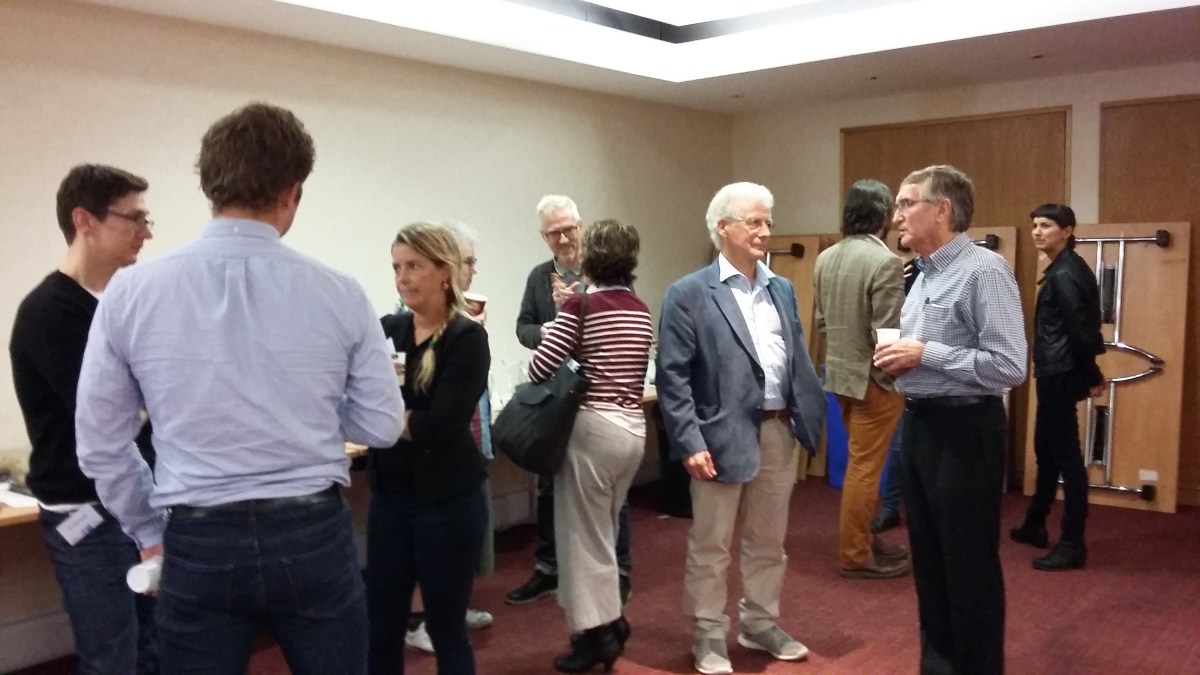
On October 24, 2016, the CauseHealth crowd met with a small group of other philosophers, healthcare practitioners, and members of the guidelines community. We had a rousing discussion that lasted the whole day, with few pauses and enthusiastic participation from all in attendance. We talked about several issues with how guidelines are developed and implemented and how we thought philosophy could be relevant in solving those issues.

It is difficult to summarize the discussion in a few words—the topics were wide-ranging and participants shared complex ideas from multiple perspectives. I’m going to highlight here some of the themes that came up more than once, and to give an idea of where the group thought the discussion should go next.

Read more of Samantha’s review of the workshop
Read Rani on Real v. Ideal Guidelines
Read Elena on How Decisions are Made
Read Karin on the Ethics of Reduction
Read Stephen on the Notion of Guideline
Read Roger on the Challenges to Come
Read Fiona on Guidelines in Situ
Read Sarah on Truth, Simplicity and Personalization
Read Anna Luise on Challenging Multi-Morbidity
Read Stephen on Standards for Regulation
Read Samantha on Analogies and High-Stakes Inferences
Continue reading “Thinking about guidelines”

The Person-Centred Care of Medically Unexplained Symptoms – a revolution is afoot

Another great summary of one of our events by @osteofm! So glad she could attend and give such a fab review 🙂 (pssst check out her blog, there are other great posts there)

osteofm's avatarosteofm

A one day symposium, at St George’s, University of London, 28 September 2016. 

A collaboration between the European Society for Person Centered Healthcare, and the CauseHealth Project.

OK.  Take a deep breath.  I just did.  Because on opening my notebook to begin trying to make sense of this amazing one-day Symposium in London, I have discovered that I took 32 pages of notes.  And I didn’t even get everything down.  Yes it was packed with intellectual stimulation,  organized by the exciting CauseHealth people, in collaboration with the ESPCH, who are all very brainy and who are exploring a field so fascinating, far-reaching and multi-layered that it’s not easy to even define.  There was politics, philosophy, taxonomy, research, education, neurology, psychology, croissants.  What’s not to like?  So prepare yourself.  As blogs go, this is a long one.

Andrew Miles– (please forgive the absence of titles and letters for…

View original post 3,338 more words

New CauseHealth publication about risk assessment of drugs.

Capture


In Bridging the Boundaries Between Scientists and Clinicians, Elena Rocca explores the field of drug risk assessment as an example of strict interdependence between basic biomedical research, clinical research, and clinical evaluation and shows how it would benefit from a closer collaboration between scientists and clinicians. Continue reading “New CauseHealth publication about risk assessment of drugs.”

Reductionism isn’t enough for public health

humanmachine2
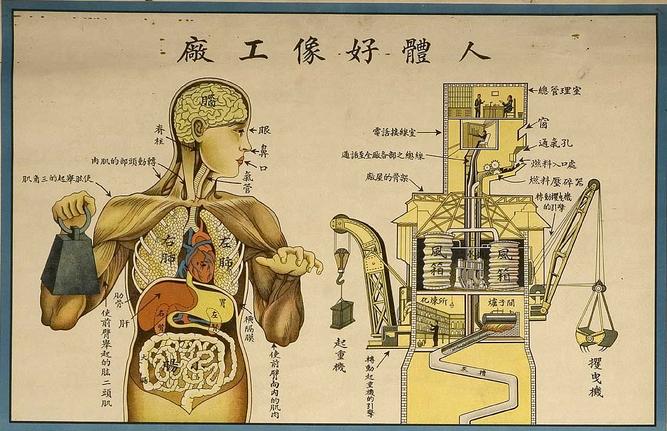
Chinese medical poster, 1933 (ref US NLM; image source here)

By Håkon Boman Andresen

The overarching goal of the public health sciences is to increase the population’s health. Society spends a lot of money each year on health research, which again is used to develop public policies and guidelines. However, is this causing the population to have better health? Continue reading “Reductionism isn’t enough for public health”