A digital CauseHealth course for health professionals

Photo credits: UMC – WHO Uppsala Monitoring Centre

We, Elena Rocca and Rani Lill Anjum, are now debating whether to establish a new CauseHealth teaching course. The course would be directed at health professionals and others who might be interested in learning more about causality, complexity and evidence for health sciences from a philosophy of science perspective.

In the last years, we have both been teaching and presenting CauseHealth material to various health professionals, but we think the time is right to offer something more structured, available, flexible and predictable.

Course themes could include (but please suggest more):

  • Philosophical bias (basic implicit assumptions) in health sciences and how they influence healthcare practice
  • The clinical squeeze between populations and the unique individual
  • Complexity, reductionism, and the biomedical model
  • Risk and safety as statistical frequencies or individual propensities
  • Ontological and epistemological tensions between evidence based and person centered practice
  • Why one size does not fit all in healthcare
  • Other ideas?

Possible formats could be (but please suggest other):

  • Digitally available course material + 2 or 3 weekends or evenings with online lectures and group discussions (3 hours each)
  • An offer of smaller modules where one can choose one or more micro-courses (4 hours each, plus some reading and preparations)
  • An intensive course that runs over 3 days
  • A flexible course that runs over 3 months
  • Other alternatives?

We would love to hear from you if you think this could be interesting, and what content and formats could be more suitable or relevant.

When it comes to expected costs, Norwegian continuous education is not very expensive, since the norm is that education is free of charge. But for continuous education, a fee of 400-700 Euros would be quite standard, since the universities will have to cover the expenses for course administration and teaching.

Access to all course material (articles, books, etc.) would be open access or included in the fee.

Toward a just mental health service

by Rolf Sundet

Rolf is Specialist in clinical psychology and Professor Emeritus, University of South-Eastern Norway, Faculty of Health and Social Sciences, Department of Health, Social and Welfare Studies, Centre for Mental Health and Substance Abuse.

In June 1972 I got off the bus outside the village of Lier, Norway, slowly walking towards the regional mental hospital. I was 18 years old with both anxiety and tense expectation about this new experience; working as a nursing assistant in a mental hospital. I was received by the nursing principal who informed me that I was to work on Ward 23. I was sent on a round to get my nursing assistant uniform, keys and a place to stay. My living quarters was in a house named the House of Brothers.

Continue reading “Toward a just mental health service”

WHAT NEXT? Reality-testing systemic resistance towards treating the whole person, the unique patient

Brian Broom, immunologist, psychotherapist and CauseHealth senior advisor

Most Western clinicians who pursue a person-centred approach to physical illness experience significant resistance from colleagues and health institutions. At first glance this may seem strange. Wouldn’t everybody want to be person-centred and oriented to the unique patient? Isn’t it obvious that the appearance and development of disease is commonly multi-causal and multidimensional? Surely anyone can see that disease is a manifestation or representation within, and of, the ‘whole’, whether that ‘whole’ is the presenting individual, or a bigger ‘whole’, such as family or culture. But life is not so simple. (This blog post is an extract. Read the long text here.)

Continue reading “WHAT NEXT? Reality-testing systemic resistance towards treating the whole person, the unique patient”

How do we care for the unique patient within evidence based practice?

Link to YouTube recording

Roger Kerry, Rani Lill Anjum, Christine Price, Joost van Wijchen

A guided dialogue between the challenges of caring for the unique patient within EBP. Exploring causality, complexity, mindlines and dispositionalism. Diving into CauseHealth.

Ton Satink, Maria Nordheim Alme, Matthew Low, Evie Martin, Paul Beenen, Ayca Corekci, Laura Rathbone, Sigurd Mikkelsen, Vegard Pihl Moen, Nokuthula Zulu, Beth Potter 

A meta-discussion on complexity – by Evie Martin and Bill Taylor

“Inspired by the Words Matter podcast’s Cause Health Series, Bill Taylor and Evie Martin discuss their reactions to the ideas presented in the podcast. They discuss how they think the biopsychosocial model has influenced physiotherapy practice for better or worse, and how we can “move beyond” it in clinic, as suggested by the Cause Health project.”

Read more and watch the video chat on the Get Better website.

Complexity; simplified – A video chat on the complex patient, causation, and manual therapy with Walt Fritz, Stephen King and Rani Lill Anjum

The video chat was recorded by Stephen King, co-founder of Vocal Health Education, and appears in the second tier qualification they offer; The Vocal Health Practitioner. Watch the video on physical therapist Walt Fritz‘s website, Foundations in Manual Therapy – Science Informed Manual Therapy Education, where he also offers a range of educational resources on patient centred manual care.

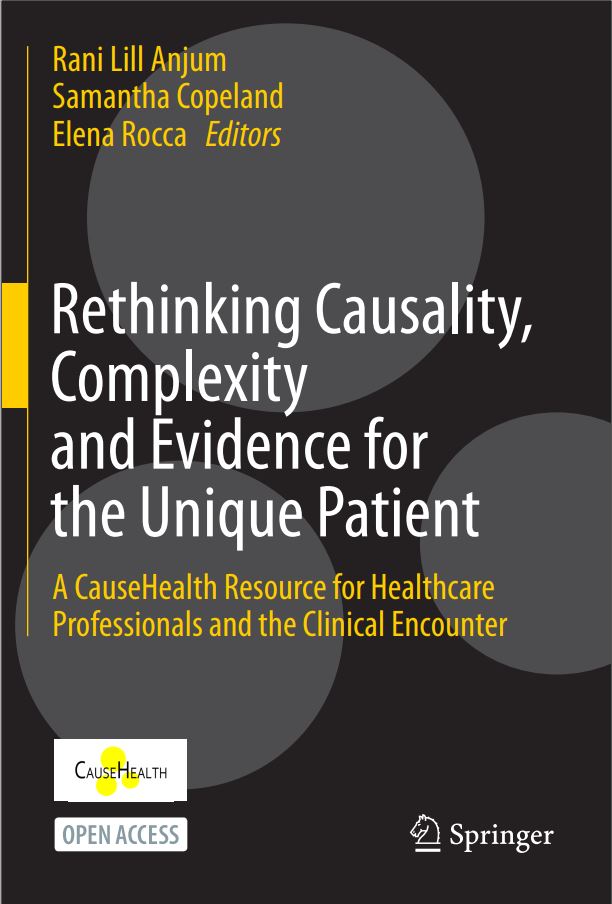
Open access CauseHealth resource for clinicians

A multidisciplinary book dealing with the philosophical biases that tacitly motivate evidence based and person centered clinical practice.

Short presentation video

Access and download the book for free on the Springer webpage.

Long presentation video

New CauseHealth resource in progress for healthcare professionals

img_4757_2

Instead of a normal final report for the CauseHealth project, we decided to write an open access book specifically for healthcare professionals. The book is meant as a resource for those interested in the relationship between their daily practice and the philosophical assumptions that motivate this practice. Continue reading “New CauseHealth resource in progress for healthcare professionals”

A personal reflection on person-centred care and the role of stories in healthcare


treatment-1327811_1920

by Stephen Tyreman

This is an extract from a recent article written by Stephen Tyreman for the International Journal of Osteopathic Medicine. The full text can be found here.

Understanding what person-centred means is much more complex and multi-factorial than I once assumed. It is not merely a question of considering a person’s individual needs and concerns and putting them first. It is recognising that human beings face up to the challenge of illness, pain and disability differently from how we might understand and seek to correct a fault in a car, say. Continue reading “A personal reflection on person-centred care and the role of stories in healthcare”

Glasses and Blind Spots: Through the Eyes of a Tester

Author Wenche Schrøder Bjorbækmo
(#4 in the Whole Person reflections series)

The test’s glasses and blind spots – seen through the confession and experience of a tester. Continue reading “Glasses and Blind Spots: Through the Eyes of a Tester”