A digital CauseHealth course for health professionals

Photo credits: UMC – WHO Uppsala Monitoring Centre

We, Elena Rocca and Rani Lill Anjum, are now debating whether to establish a new CauseHealth teaching course. The course would be directed at health professionals and others who might be interested in learning more about causality, complexity and evidence for health sciences from a philosophy of science perspective.

In the last years, we have both been teaching and presenting CauseHealth material to various health professionals, but we think the time is right to offer something more structured, available, flexible and predictable.

Course themes could include (but please suggest more):

  • Philosophical bias (basic implicit assumptions) in health sciences and how they influence healthcare practice
  • The clinical squeeze between populations and the unique individual
  • Complexity, reductionism, and the biomedical model
  • Risk and safety as statistical frequencies or individual propensities
  • Ontological and epistemological tensions between evidence based and person centered practice
  • Why one size does not fit all in healthcare
  • Other ideas?

Possible formats could be (but please suggest other):

  • Digitally available course material + 2 or 3 weekends or evenings with online lectures and group discussions (3 hours each)
  • An offer of smaller modules where one can choose one or more micro-courses (4 hours each, plus some reading and preparations)
  • An intensive course that runs over 3 days
  • A flexible course that runs over 3 months
  • Other alternatives?

We would love to hear from you if you think this could be interesting, and what content and formats could be more suitable or relevant.

When it comes to expected costs, Norwegian continuous education is not very expensive, since the norm is that education is free of charge. But for continuous education, a fee of 400-700 Euros would be quite standard, since the universities will have to cover the expenses for course administration and teaching.

Access to all course material (articles, books, etc.) would be open access or included in the fee.

WHAT NEXT? Reality-testing systemic resistance towards treating the whole person, the unique patient

Brian Broom, immunologist, psychotherapist and CauseHealth senior advisor

Most Western clinicians who pursue a person-centred approach to physical illness experience significant resistance from colleagues and health institutions. At first glance this may seem strange. Wouldn’t everybody want to be person-centred and oriented to the unique patient? Isn’t it obvious that the appearance and development of disease is commonly multi-causal and multidimensional? Surely anyone can see that disease is a manifestation or representation within, and of, the ‘whole’, whether that ‘whole’ is the presenting individual, or a bigger ‘whole’, such as family or culture. But life is not so simple. (This blog post is an extract. Read the long text here.)

Continue reading “WHAT NEXT? Reality-testing systemic resistance towards treating the whole person, the unique patient”
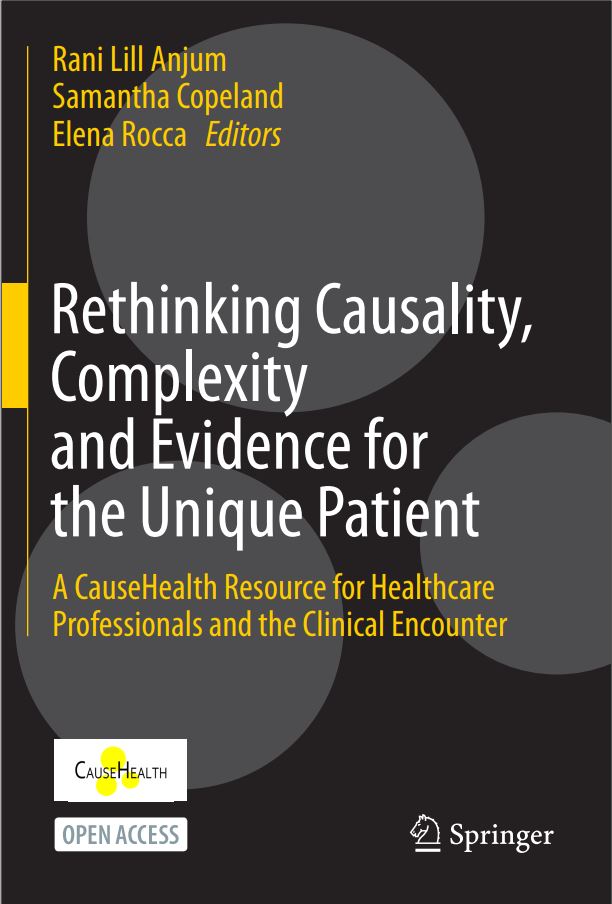

Open access CauseHealth resource for clinicians

A multidisciplinary book dealing with the philosophical biases that tacitly motivate evidence based and person centered clinical practice.

Short presentation video

Access and download the book for free on the Springer webpage.

Long presentation video

Evidence based medicine. What evidence, whose medicine, and on what basis?

girl-2696947_1920

Rani Lill Anjum

The evidence-based medicine movement was intended as a methodological revolution. Its proponents suggested the best way to establish the effectiveness of treatment and new criteria to choose between available treatments without bias. Philosophically, however, these changes were not so innocent, at least not ontologically speaking. In bringing itself closer to science, medicine has become less suitable for dealing with complex illnesses, individual variations and, as I will argue, with causation in general. Continue reading “Evidence based medicine. What evidence, whose medicine, and on what basis?”

CauseHealth workshop N=1 is now a section in JECP special issue.

Capture

The Journal of Evaluation in Clinical Practice has dedicated a section of its latest special issue to collect seven contributions which were previously presented in the CauseHealth workshop N=1. A further contribution from the same workshop was published by the same journal last year. Continue reading “CauseHealth workshop N=1 is now a section in JECP special issue.”

#CauseHealthPT Holds Court: The Beginning of The Beginning

DSC_0127[1]

By Roger Kerry

How and why has this philosophy project got itself so involved with physiotherapy? The background to the CauseHealth project is essentially that the world of health care is not straightforward, and indeed is characterised by complexity and context-sensitivity. Physiotherapy is a profession where these characteristics are easily visible, and so serves as a great ‘testing ground’ for the philosophical work being done by CauseHealth. This in turn helps the project better understand its ideas. In doing this, physiotherapy itself gets a deep and critical understanding of the job it does, and of the scientific research which informs it. We are now symbiotic! Continue reading “#CauseHealthPT Holds Court: The Beginning of The Beginning”

Why do we care about the foundations of evidence-based medicine (“EBM”)?

1280px-Lotyšské_etnografické_muzeum_v_přírodě_(91)
Photo via Latvian Ethnographic Open Air Museum

by Samantha Copeland

CauseHealth has been pushing buttons all over the place, lately, as we pursue our goal of critiquing current frameworks in EBM by proposing some deep questions about its ontology*. We aren’t the only ones—at recent events, we have found people from various communities in medicine are ready and willing to raise and engage some tough questions, about what evidence is and how it might best be used. Reflecting on two recent events we attended, in this blog post I want to think a little bit about the relationship between understanding the foundations of EBM, and putting the ideals of EBM to work for us in medical practice. Continue reading “Why do we care about the foundations of evidence-based medicine (“EBM”)?”

The CauseHealth and Trinity workshop “N=1 – causal reasoning in clinical practice”

by Elena Rocca

The workshop “N=1 – causal reasoning in clinical practice” was a perfect start of the new year for the CauseHealth friends. On the 12th of January the NMBU University campus in Ås welcomed us with a beautiful snowy landscape, and authentic Norwegian winter. Continue reading “The CauseHealth and Trinity workshop “N=1 – causal reasoning in clinical practice””

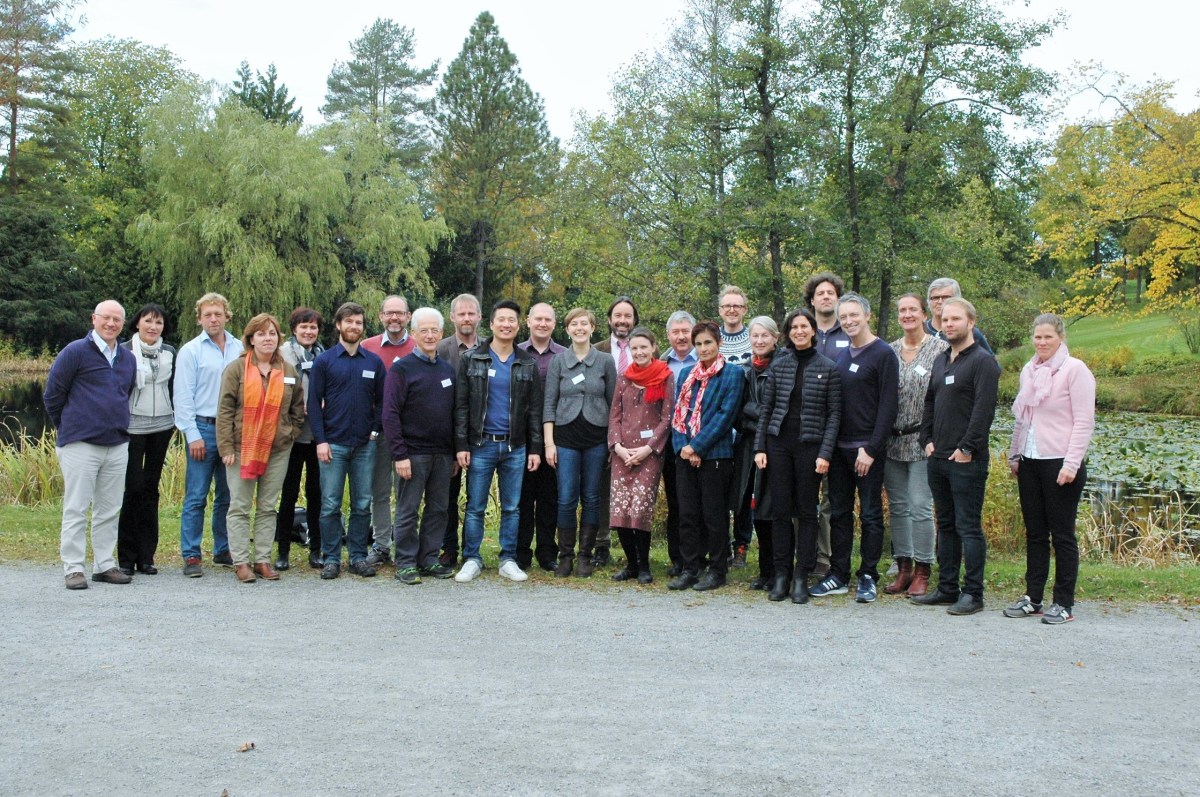
The first CauseHealth meeting

By Samantha Copeland

This CauseHealth network meeting brought together philosophers, medical practitioners and researchers in the health sciences to share their perspectives on human health and illness. Read about the first meeting in their guest editorial for the European Journal for Person Centered Healthcare. Continue reading “The first CauseHealth meeting”