How Decisions are Made

Elena Rocca, Thinking about guidelines:

I was interested in a question that Sietse threw at us many times: what should be the purpose of a guideline? What does “helping to make a good decision” mean?

We got some inputs about it throughout the whole day: it might mean including the patient view, or reporting only the evidence with no recommendation, or giving recommendation but being transparent about which evidence was considered and how it was judged, or again, as Sietse suggested, it might mean to explain what is “to make an inference”, what happens when a clinical decision is made. I was particularly interested in this last suggestion, and I felt it remained a bit “in the air”. Does it mean that we would need a guideline about the decision process? About the implicit and sometimes unaware stand that the clinician takes by valuing one or the other evidence, following the guideline versus personal judgement?

Real v Ideal Guidelines

Rani Lill Anjum, Thinking about guidelines:

I was really interested in the questions of how guidelines could include more leeway for the health professional. Rigid guidelines offering cost efficient solutions (e.g. 15 minutes per patient, or 30) emphasises the rule utilitarian approach and makes it difficult to use judgement and experience to give the best health service for the individual patient. If the patient represents at least as much of the causally relevant evidence (medical history, genetics, life situation, etc.) as population data, then how come the latter is given epistemic priority?

I thought that there were many good intentions behind the guidelines, but also a wide range of interests depending on who commissioned the guideline and what they want to use it for. This is why I thought the tension between real and ideal is important. New public management emphasises top down management, controlling, reporting, standardisation and efficiency. In the clinical setting, this approach might create chronic illness, if we simply treat or test the symptoms that the patient reports. Those who work on the importance of patient context and stories (Trish, Matt, Brian, Anna-Luise) have important knowledge to share, and show also that the most efficient treatment of such illness is to take more time with the patient to figure out what is actually wrong before offering an intervention or a test. Why could this not be in guidelines about chronic illness, MUS and comorbidity? Then we would also avoid reductionism and dualism of treatment.

Thinking about guidelines

clock-lion
National Geographic Wild, Trafalgar Square in London, January 28, 2016.

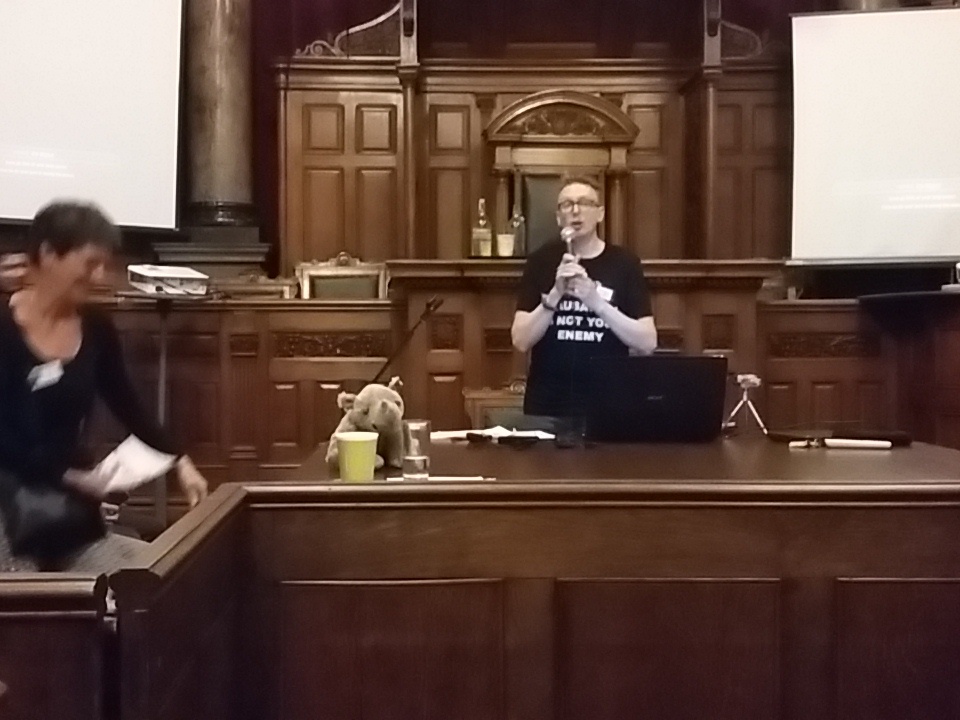
On October 24, 2016, the CauseHealth crowd met with a small group of other philosophers, healthcare practitioners, and members of the guidelines community. We had a rousing discussion that lasted the whole day, with few pauses and enthusiastic participation from all in attendance. We talked about several issues with how guidelines are developed and implemented and how we thought philosophy could be relevant in solving those issues.

It is difficult to summarize the discussion in a few words—the topics were wide-ranging and participants shared complex ideas from multiple perspectives. I’m going to highlight here some of the themes that came up more than once, and to give an idea of where the group thought the discussion should go next.

Read more of Samantha’s review of the workshop
Read Rani on Real v. Ideal Guidelines
Read Elena on How Decisions are Made
Read Karin on the Ethics of Reduction
Read Stephen on the Notion of Guideline
Read Roger on the Challenges to Come
Read Fiona on Guidelines in Situ
Read Sarah on Truth, Simplicity and Personalization
Read Anna Luise on Challenging Multi-Morbidity
Read Stephen on Standards for Regulation
Read Samantha on Analogies and High-Stakes Inferences
Continue reading “Thinking about guidelines”

#CauseHealthPT Holds Court: The Beginning of The Beginning

DSC_0127[1]

By Roger Kerry

How and why has this philosophy project got itself so involved with physiotherapy? The background to the CauseHealth project is essentially that the world of health care is not straightforward, and indeed is characterised by complexity and context-sensitivity. Physiotherapy is a profession where these characteristics are easily visible, and so serves as a great ‘testing ground’ for the philosophical work being done by CauseHealth. This in turn helps the project better understand its ideas. In doing this, physiotherapy itself gets a deep and critical understanding of the job it does, and of the scientific research which informs it. We are now symbiotic! Continue reading “#CauseHealthPT Holds Court: The Beginning of The Beginning”

Are physiotherapists the new philosophers? CauseHealth 2016

Reflections from the CauseHealth Physio conference in Nottingham in May, guest blog.

osteofm's avatarosteofm

260 Here’s where it happened: The Galleries of Justice Museum, in the trendy Lace Market area of Nottingham

I can’t remember why I raced to book a ticket to the CauseHealth Conference in Nottingham in May.  It might have been because it only cost £35 (lunch included!), it might have been because lots of keen-minded people I follow on twitter were excited about it (sports physio Adam Meakins, Neil Maltby, Chews Health…), it might be because the word philosophy excites my brain, but whatever the reasons I found myself walking into an old wood-panelled courtroom, (usually a museum) in Nottingham’s Lace Market, not having a clue what it was going to be about.  All I knew was that I suspected it was at the cutting edge of health care, particularly for manual therapists.  And I was right.  It was intense, it was highly learned, it was powerful and I couldn’t take…

View original post 1,812 more words

Why do we care about the foundations of evidence-based medicine (“EBM”)?

1280px-Lotyšské_etnografické_muzeum_v_přírodě_(91)
Photo via Latvian Ethnographic Open Air Museum

by Samantha Copeland

CauseHealth has been pushing buttons all over the place, lately, as we pursue our goal of critiquing current frameworks in EBM by proposing some deep questions about its ontology*. We aren’t the only ones—at recent events, we have found people from various communities in medicine are ready and willing to raise and engage some tough questions, about what evidence is and how it might best be used. Reflecting on two recent events we attended, in this blog post I want to think a little bit about the relationship between understanding the foundations of EBM, and putting the ideals of EBM to work for us in medical practice. Continue reading “Why do we care about the foundations of evidence-based medicine (“EBM”)?”

PhD thesis on serendipity wins award

Samantha Marie Copeland

Philosopher and CauseHealth Postdoc, Samantha Copeland, has won one of two Best Thesis Awards from Dalhousie University for her doctoral thesis The Case of the Triggered Memory: Serendipitous Discovery and the Ethics of Clinical Research. She has also been selected as their nominee for the Canadian Association for Graduate Studies Distinguished Dissertation Award in Fine Arts, Humanities and Social Sciences for 2016. Congratulations! Read more about her work on serendipity and get the full text version of the thesis.

CauseHealth events in Nottingham and Madrid

It is an exciting spring for the CauseHealth project. In January, we organised the N=1 workshop here at NMBU. And in May and June our partner institutions will host a conference in Nottingham and a one-day symposium in Madrid. Continue reading “CauseHealth events in Nottingham and Madrid”

You’re History (Hasta la Vista, baby)

By Neil Maltby — author of the becomingmorehuman blog, a physiotherapist in the UK, and a CauseHealth collaborator

She seemed straight forward enough on assessment. 45yrs old. Sudden pain onset from a seemingly innocuous movement many years ago. Episodic but progressive back pain since. Almost full range of movement. No significant neurological, inflammatory, vascular or other suspicious signs. One thing did sit in my mind though. It was as I asked her to reach down to the floor. Continue reading “You’re History (Hasta la Vista, baby)”

N=1 Reflections Roundup

by Samantha CopelandDSC_0033

I’d like to shout out a hearty thank you for the last two weeks’ contributions from the
participants in our January workshop, N=1: Causal Reasoning and Evidence for Clinical Practice! A diverse group of participants has given us a variety of things to think about, compliments to savour, and tough questions to ponder—thank for making February interesting too.
Continue reading “N=1 Reflections Roundup”